Claude Opus 4.8: what actually changes when you code for real
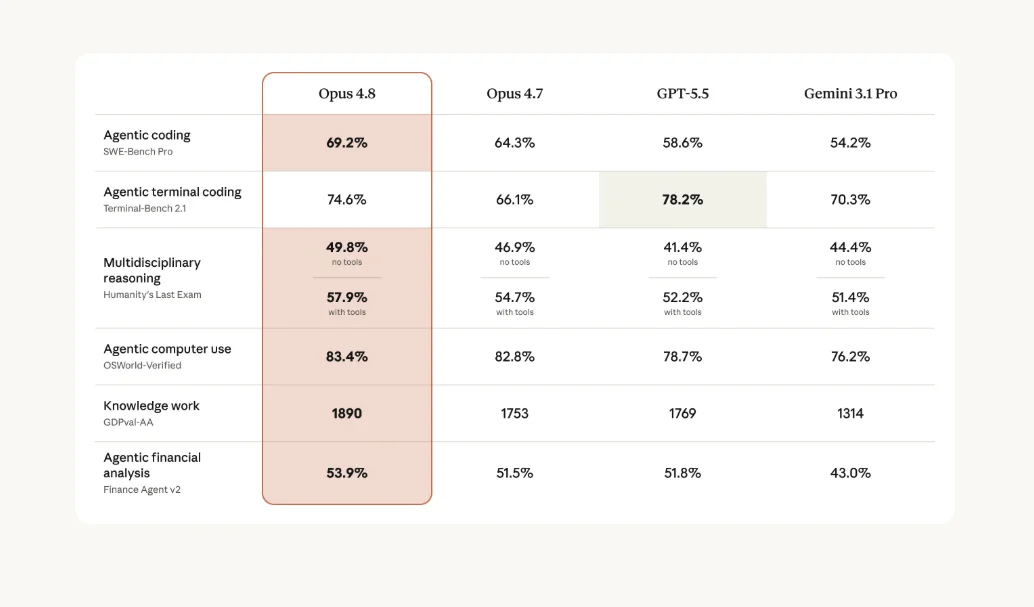
Anthropic has just released Claude Opus 4.8.
The price stays the same, Claude Code gets a few new features, and the overall message is pretty clear: better coding reliability, stronger support for long-running tasks, and more useful agents for complex workflows.
I would not call it a revolution.
But as a developer, there are a few things here that are definitely worth looking at.
Reliability is becoming the real topic
The part that caught my attention the most is this: according to Anthropic, Opus 4.8 is about 4 times less likely to miss a bug in code it has just written.
There is another point I find even more important: the model seems better at saying when it is unsure, instead of confidently telling you that everything is fine.
When you work with AI-generated code on a regular basis, that matters.
I would much rather have a model say “this needs review” than one that is wrong with perfect confidence.
Effort control
Another interesting addition is effort control.
Next to the model selector, you can now choose how deeply you want Claude to work on a task. By default, Opus 4.8 runs in high mode, but you can push it to extra or max for more complex work.
The idea is practical: not every task needs the same level of reasoning.
For a small fix, you do not need to bring out the heavy machinery.
For a delicate refactor, a technical migration, or an agent working for a long time across a codebase, asking for more depth can make sense.
That said, it is important not to confuse things: this setting does not replace choosing the right model. It changes how Opus approaches a specific task.
Dynamic workflows in Claude Code
In Claude Code, Anthropic is also introducing dynamic workflows in preview.
The idea is ambitious: Claude can break down a large task, launch multiple agents in parallel, review their outputs, and come back with a consolidated result.
The example Anthropic gives is quite telling: a migration across an entire codebase, with hundreds of thousands of lines, from launch to merge, using the test suite as a safety net.
On paper, this is exactly the kind of feature that could change how we approach large refactors.
To illustrate this part, Anthropic has also published an interesting video about long-running tasks with Opus 4.8 and Claude Code:
Now, as always, the real test will be how this behaves on actual projects.
With strange dependencies.
With inherited technical decisions.
With incomplete tests.
And with all those little surprises that only appear when you touch an application that has been running in production for years.
What does this mean for Symfony, Laravel or PrestaShop?
This is where it gets interesting for me.
In real web projects, we do not work on clean, isolated examples. We work with legacy code, modules, services, controllers, jobs, third-party integrations, and architectures that have often been through several hands.
In that context, these improvements could be genuinely useful.
A few cases where I can see value:
- analysing a large part of a codebase without having to split everything manually;
- preparing a technical migration with more clarity;
- identifying risky areas before touching sensitive code;
- asking for a more cautious review of a refactor;
- keeping an agent focused on a long-running task without constantly repeating the context.
The 1M token context window, inherited from previous versions, is still interesting for these scenarios. But I remain cautious: having more context does not automatically mean understanding a project better.
On paper, it sounds powerful.
In practice, it needs to be measured.
Pricing
The standard pricing stays the same: $5 per million input tokens and $25 per million output tokens.
Prompt caching can significantly reduce costs when you reuse a lot of context, and fast mode is now much cheaper for cases where speed matters more than depth.
Opus 4.8 is available on Claude Pro, Max, Team, Enterprise, through the Claude API, and also on AWS, Google Cloud and Microsoft Foundry.
My take for now
I do not see Claude Opus 4.8 as a breakthrough.
I see it more as a maturity update.
Less misplaced confidence.
More control.
Better support for long-running tasks.
And potentially a more useful tool for working with real code, not just small, clean examples prepared for a demo.
👋 I’m Jatniel Guzmán, senior freelance PHP developer.
I help startups, SMEs, agencies and enterprise teams design, evolve and optimise their web applications, REST APIs and e-commerce platforms.
Symfony, Laravel, PrestaShop, PHP migration, legacy code modernisation, performance and maintainability: I step in where existing systems need to become more reliable, clearer and easier to maintain over time.
Website: https://jatniel.dev
LinkedIn: https://www.linkedin.com/in/jatniel/
GitHub: https://github.com/jatniel
Malt: https://www.malt.fr/profile/jatniel